Fifteen years in a classroom.
For fifteen years, Shani taught English literature in an Israeli high school - a teacher and educator who believed in the slow, patient work of shaping young minds. It was a life of structure, of lesson plans and quiet routine.
That changed in 2014, when a single Facebook post she wrote about surviving sexual assault at nineteen went viral - three and a half years before the global #MeToo movement. What followed was not something she planned.
A voice for the ones who had none.
Shani left teaching to found and lead Ot Hizdahut - an Israeli nonprofit supporting survivors of sexual assault. For five years, she became one of the country's most recognized advocates against sexual violence, accompanying hundreds of survivors personally, lecturing across Israel's military bases for the Ministry of Defense, and appearing before the Knesset and at presidential events.
"I felt like Little Red Riding Hood walking through a forest of wolves - and still handing out cookies."
She gave everything to that work. There was no day off, no quiet Friday dinner that wasn't interrupted by a survivor in crisis. By forty-five, she was carrying the weight of thousands of stories that were not her own, alongside her own.
When the hands that wiped away tears began to create.
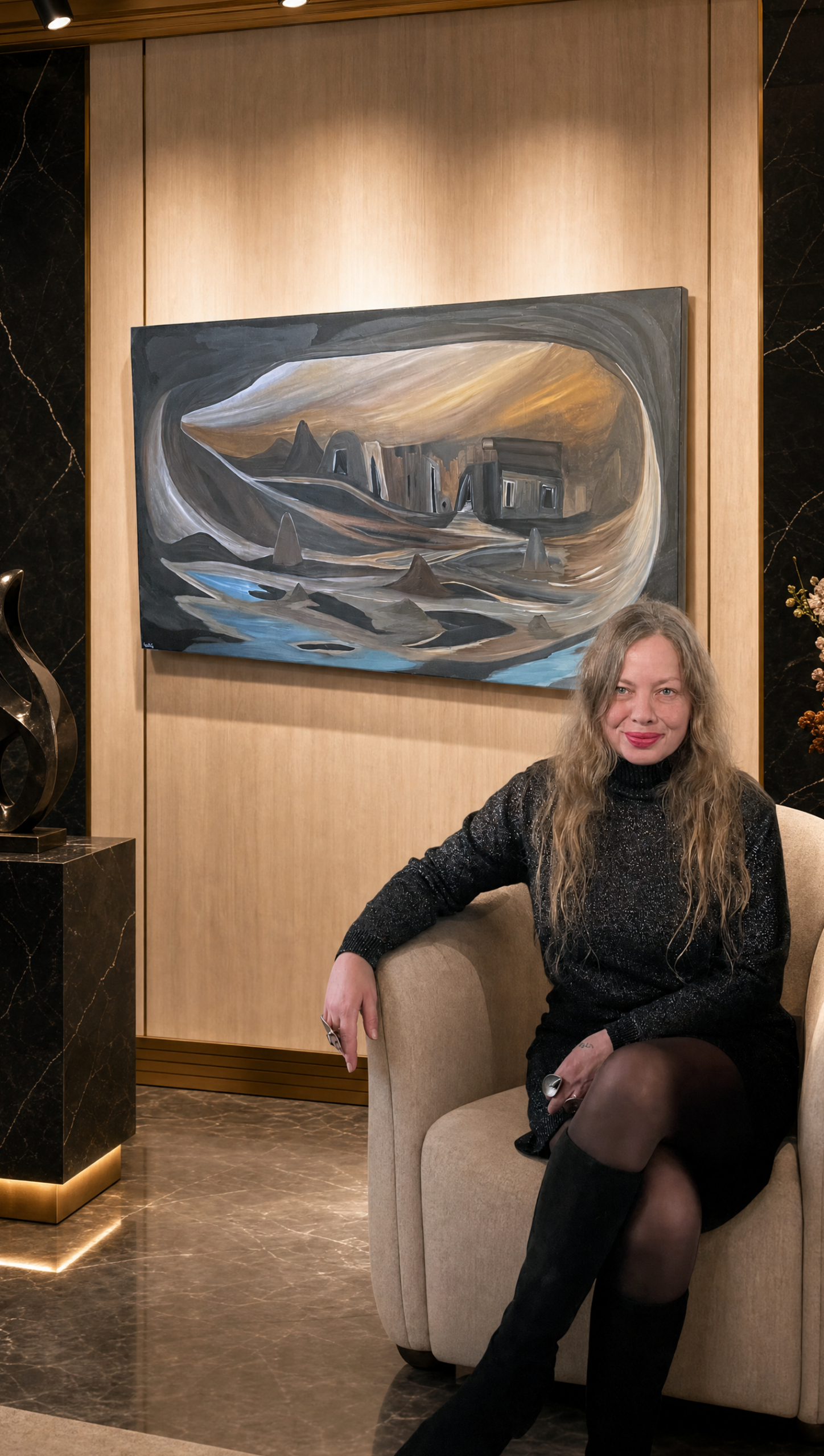
At forty-five, Shani closed the organization she had built. Not from failure - from exhaustion, and from a need to return to herself. She picked up a brush for the first time in any serious way less than four years ago. Painting became something her years of advocacy work never could be: a private language, with no one else's pain inside it.
She began selling original paintings roughly three years ago. What started as therapy became a body of work - over a hundred original paintings, collected by private buyers and interior designers internationally.
Memory that arrives in pieces.
Shani carries little continuous memory from her early life - the result of childhood trauma that fractured how the past is stored. Her paintings are not illustrations of memories. They are what surfaces when there is no full memory to draw from: a fragment, a feeling, a half-formed image that insists on being finished in paint rather than words.
This is also why animals appear so often in her work. As a child who felt unprotected, she found in animals a steadiness humans hadn't offered her - a wordless companionship that became, later, a recurring language of healing inside her paintings.